Building a house or a building in Spain: licences, land and contracts
To build a house or a building in Spain, you need land classified as urban, a building licence and an approved technical project. The process is complex, and any error can cause significant delays and cost overruns. This article explains the key stages of the building process, the practical risks, and the contracts you must manage to protect your investment.
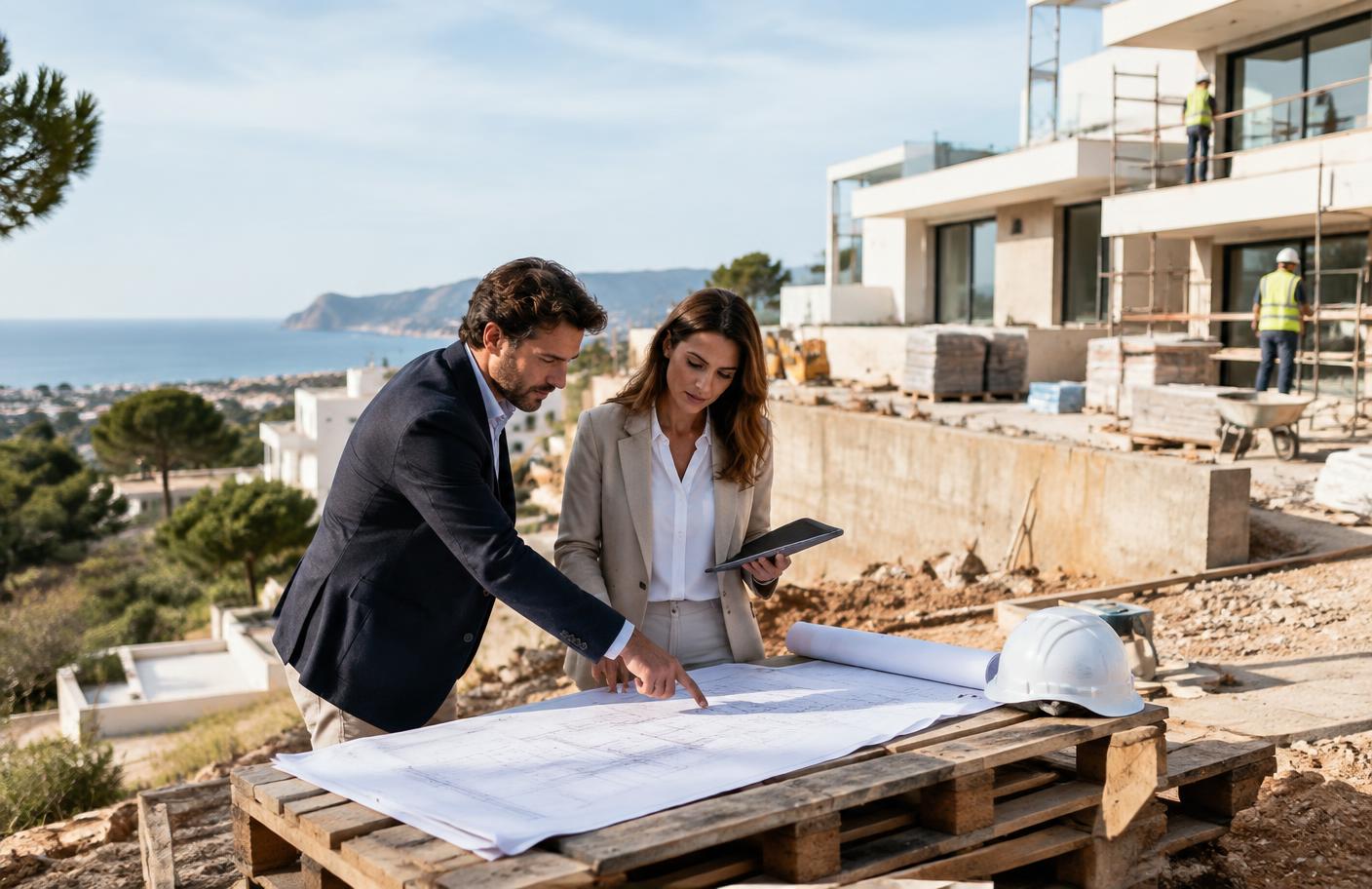
Key points:
- The land must have the correct planning classification for the construction you are planning.
- A municipal building licence is an essential requirement, and obtaining it can be a lengthy process.
- Contracts with the architect, technical architect or surveyor, and the construction company must clearly define responsibilities, deadlines and costs.
- The Ley de Ordenación de la Edificación (Building Management Act) regulates the obligations of all agents involved in the construction process.
The starting point: the land
The success of a property project begins with the choice of land. Spanish urban planning regulations, primarily managed by local Town Halls (ayuntamientos), classify land into different categories. The most relevant for construction is urban land, which already has basic utilities (water, electricity, sewerage, road access) and allows for direct building.
Before acquiring a plot, it is essential to conduct urban planning due diligence. This involves reviewing the Plan General de Ordenación Urbana (PGOU) [General Urban Development Plan] and other local regulations to confirm not only that the land is urban but also what exactly can be built on it: building typology (single-family home, multi-family block), maximum height, buildable area, setbacks, etc.
Purchasing land without this prior verification can make it impossible to execute the project as planned, completely blocking the investment.
The administrative process: licences and permits
No new build work can begin without authorisation from the corresponding Town Hall. The main permit is the building licence, which is applied for by submitting a detailed project design.
This project is a detailed technical document, drafted and signed by an architect, which describes all aspects of the construction. It includes everything from plans and structures to installations and finishes, and must be approved by the corresponding professional body (colegio profesional).
The timeframe for obtaining the licence varies enormously between municipalities and can take months or, in large cities, even more than a year. An incomplete or incorrect application will only cause further delays. Starting work without a licence can lead to very serious financial penalties and a demolition order for what has been built.
Frequently asked questions about land and licences
-
Can you build on rural land? As a general rule, no. Rural land (suelo rústico) is protected, and its primary use is for agriculture, livestock farming or forestry. The law provides for very limited and specific exceptions, such as buildings linked to agricultural operations or buildings of public interest, but these require a complex authorisation process with an uncertain outcome.
-
What is a declaration of responsibility and can it be used to construct a building? The declaración responsable (declaration of responsibility) is a simplified procedure for minor works, where the developer informs the Town Hall of the start of the work, declaring under their own responsibility that they comply with all regulations. It is not valid for new build projects or works affecting the structure, for which a building licence is always required.
The agents in the building process and their contracts
The Ley de Ordenación de la Edificación (LOE) of 1999 [Building Management Act] defines the different parties involved in a construction project and their responsibilities. As the developer (promotor), you will need to hire several of them, and the strength of those contracts is your main tool for control.
The building contract
This is the contract you sign with the construction company. It must precisely regulate the scope of the work, the price (fixed price or cost-plus basis), the execution deadline, and a system of penalties for delays.
Ambiguous wording regarding the quality of materials or payment terms can lead to constant disputes, unexpected cost overruns and poor execution. The lawyers at the ARROWS International network in Spain can help you negotiate and draft a building contract that protects your interests.
Contracts with technical professionals
In addition to the builder, you will need an architect (designer and project manager) and a technical architect or surveyor (arquitecto técnico or aparejador) (construction execution manager). Their contracts must specify the scope of their services, their fees, and their responsibility for supervising the work.
| Potential problems | How ARROWS (office@arws.eu) can help |
|---|---|
| Incorrect planning classification: Purchasing land that does not permit the desired construction, blocking the investment. | Urban planning due diligence: We verify the planning and applicable regulations before purchase to ensure your project's viability. |
| Deficient building contract: Ambiguous clauses on price, deadlines or quality standards that lead to cost overruns and disputes. | Contract drafting and negotiation: We help you to clearly define the construction company's obligations to protect your investment and avoid litigation. |
| Planning sanctions: Starting work without a licence or with an incorrect declaration of responsibility, facing fines and demolition orders. | Advice and representation: We guide you in obtaining permits and represent you before the public administration to ensure regulatory compliance. |
| Disputes with the construction company: Breaches of contract, unjustified delays or defects in execution. | Conflict resolution: We mediate to find a solution and, if necessary, defend your interests in legal proceedings for construction defects. |
| Acceptance of works with defects: Accepting the completion of the work without a thorough inspection, making subsequent claims more difficult. | Assistance with handover: We assist you in the handover process and the signing of the final certificate of completion to ensure everything conforms to the agreement. |
Final summary
Constructing a building in Spain is a highly complex legal and technical operation. Deficient land planning, errors in processing licences, or poorly drafted contracts can jeopardise the entire project, leading to cost overruns, delays and serious liabilities.
For an investor or developer, anticipating these risks is fundamental. Having specialised legal advice from the outset allows you to make informed decisions, negotiate from a position of strength and ensure that the construction proceeds on a solid legal foundation.
To analyse your project and secure every step of the construction process, you can contact the lawyers at the ARROWS International network in Spain via office@arws.eu.
Frequently asked questions about building a house or a building in Spain
-
What is the Ley de Ordenación de la Edificación (LOE)? It is the main law governing the building process in Spain. It defines the agents involved (developer, builder, architect, etc.), establishes their obligations and sets out a system of guarantees and liabilities for any damage or defects that appear in the building after its construction.
-
What are my responsibilities as a developer? As the developer, you are the driving force behind the building project. Your main responsibility is to be liable to the purchasers for any material damage the building suffers. The LOE establishes three guarantee periods: 10 years for structural defects, 3 years for defects affecting habitability, and 1 year for finishing defects.
-
Is the ten-year insurance ('seguro decenal') mandatory? Yes. As the developer of a building intended primarily for residential use, the law requires you to take out a material damage insurance policy, known as seguro decenal (ten-year insurance), which covers any defects affecting the structural safety of the building for 10 years.
-
What happens if construction defects appear after handover? The developer is liable for them. Depending on the type of defect, the claim should be made against the developer, who can in turn claim against the other responsible agents (builder, architect). It is crucial to provide formal notification of the defects as soon as they are detected.
-
Do I need a First Occupancy Licence upon completion? Yes. Once the work is finished, you must apply to the Town Hall for a Licencia de Primera Ocupación (First Occupancy Licence) or an equivalent document, depending on the autonomous community. This document certifies that the building has been executed in accordance with the project and the building licence, and it is essential for contracting permanent utilities (water, electricity) and for registering the new build at the Registro de la Propiedad (Land Registry).
-
Can the ARROWS International network help me if the construction company is foreign? Yes. Thanks to its international nature, the ARROWS International network is particularly well-equipped to manage projects with cross-border elements. The ARROWS International network in Madrid can coordinate with other network offices in Europe to conduct checks on the foreign partner, draft bilingual contracts and manage any disputes that may arise.
Disclaimer
Official sources reviewed
BOE consolidated legislation cited, the Spanish Tax Agency and, depending on the subject, the College of Registrars and applicable regional and municipal rules. Editorial review completed on 5 October 2026.
Disclaimer: The information contained in this article is for general informational purposes only and serves as a basic guide on the subject according to the legal situation in 2026. Although we take the utmost care to ensure the accuracy of the content, regulations and their interpretation evolve over time. ARROWS advokátní kancelář, head of the ARROWS International network, is registered with the Czech Bar Association (its supervisory body) and holds professional indemnity insurance with a cover limit of CZK 400,000,000. To verify the current regulations and their application to your specific situation, please contact the ARROWS International network in Spain directly (office@arws.eu). We assume no liability for damages arising from the use of the information in this article without prior individual legal consultation.
ARROWS International
Discuss your project in Spain
Planning to invest or do business in Spain? Contact the ARROWS International network in Madrid.
Contact usRelated articles
Property development projects: land, licences and planning
Undertaking property development projects in Spain requires rigorous legal planning to secure land, obtain licences, and comply with planning regulations. A mistake in the initial phase can halt construction for years or generate unforeseen costs. This article details the key phases, the risks to avoid, and how proper legal management from the outset protects your investment.

How to Set Up a Company in Spain: A Step-by-Step Guide
To set up a company in Spain, the most common route is to form a private limited company (`sociedad de responsabilidad limitada` or SL), which can be created with a share capital of just €1. This process involves formalities with the `Registro Mercantil` (Commercial Registry), a notary, and the `Agencia Tributaria` (Tax Agency). In this guide, we explain the key steps to incorporate your company and the risks to avoid in order to start with a solid legal foundation.
Investing in a company in Spain: key considerations before signing
To invest safely in a company in Spain, it is essential to conduct a prior legal and financial audit, or *due diligence*. This process verifies the company's actual situation. Skipping this step can lead to assuming hidden debts or unexpected contingencies. In this article, we explain the key points to review before committing your capital.